Overview
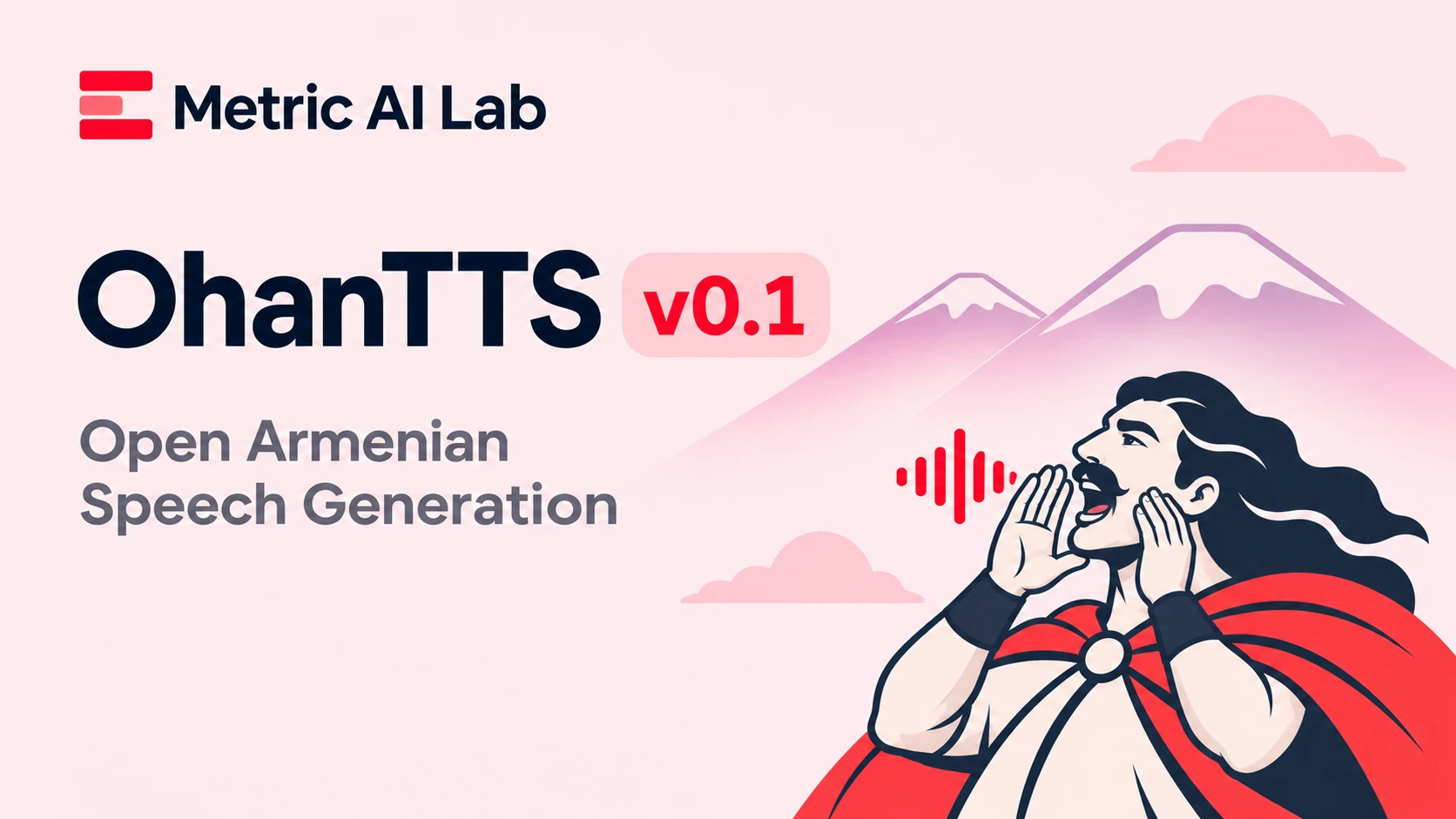
Today we're releasing OhanTTS v0.1, an open text-to-speech model built for Armenian. It clones a voice from a few seconds of audio and streams speech as it is generated, so listeners hear the first words almost immediately.
Armenian comes first, but OhanTTS also speaks English, Spanish, Arabic, Russian, Mandarin Chinese, Japanese and French. We started from a multilingual speech model and trained it further on about 160 hours of reference recordings across those eight languages, 61 hours of them in Armenian.
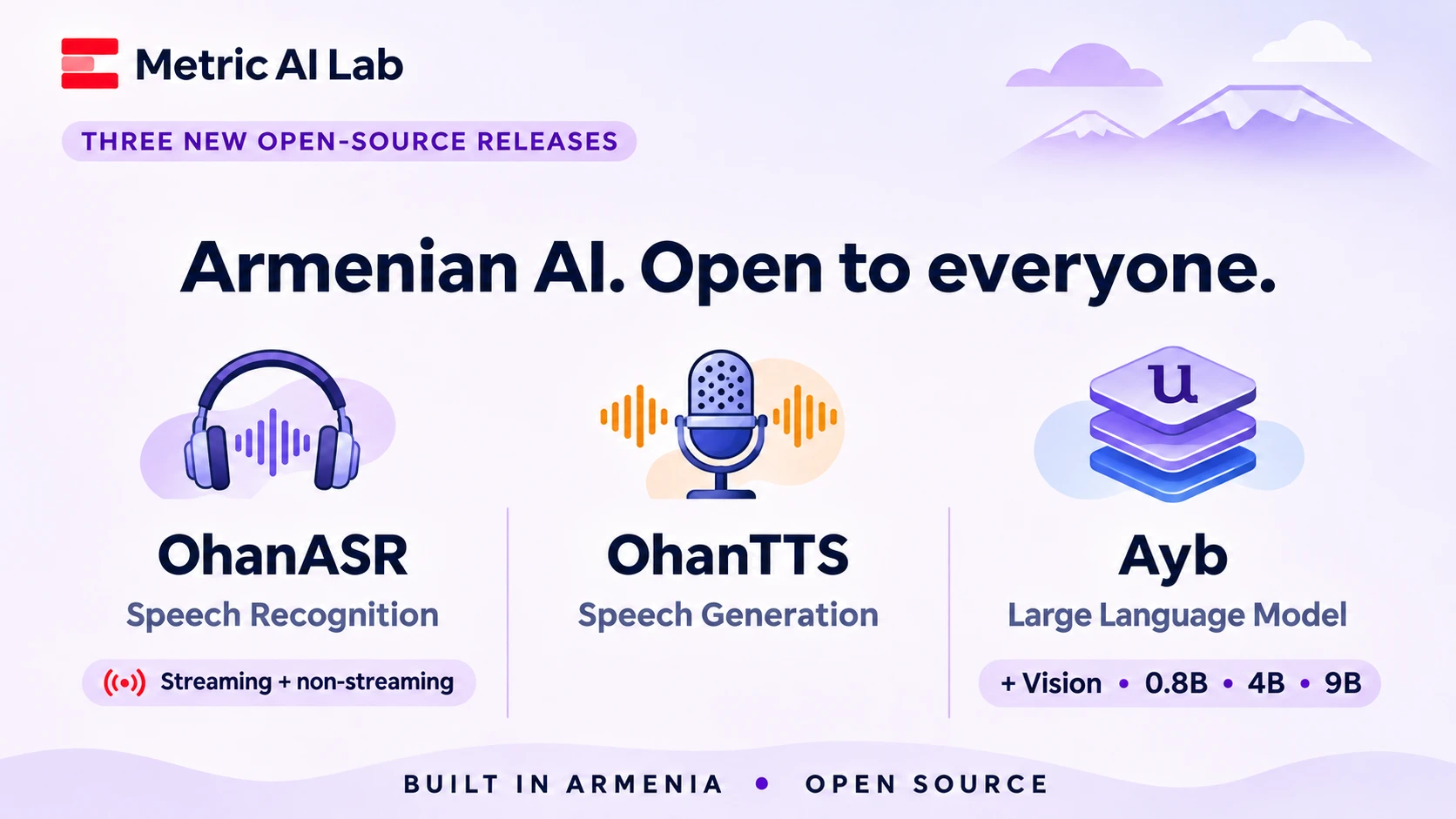
The name comes from Dzenov Ohan, Ohan the Loud-Voiced, from the epic Daredevils of Sassoun. He shares it with OhanASR, our speech recognition model: OhanASR listens and OhanTTS speaks.
Voice cloning
Give OhanTTS a 3–10 second recording and its transcript, and it will speak any new text in that voice. Below, Ohan himself introduces the model: the left clip is the reference, the right one was generated from it.
Built for streaming
Most TTS models synthesize the whole utterance before returning any audio, so the longer the text, the longer the silence. That's fine for audiobooks and too slow for a voice agent.
OhanTTS predicts audio one frame at a time and decodes each block to a waveform as soon as it is ready, so the first words reach the listener in about a third of a second while the rest is still being generated. The text is still sent in one request. Only the audio is streamed.

Results
Synthesis quality
We tested OhanTTS on held-out Armenian synthesis requests, with speakers and texts it had not seen in training.
| Metric | Result |
|---|---|
| Word error rate (WER) ↓ | 14.70% |
| Character error rate (CER) ↓ | 6.15% |
| Speaker similarity (SIM-o) ↑ | 0.693 |
WER and CER compare an automatic transcription of the generated speech with the text that was requested, so they measure intelligibility. SIM-o measures how close the generated voice is to the reference speaker.
Streaming performance
We served the model over local HTTP on a single shared NVIDIA GB10, streaming PCM audio, and increased the number of concurrent clients. With one client, audio starts in 331 ms. Even with 16 clients, every stream is still generated faster than real time (real-time factor below 1).
| Concurrent clients | Time to first audio ↓ | Real-time factor ↓ | Requests/s ↑ | Audio seconds/s ↑ |
|---|---|---|---|---|
| 1 | 331 ms | 0.178 | 0.69 | 5.59 |
| 2 | 464 ms | 0.236 | 0.90 | 7.30 |
| 4 | 651 ms | 0.302 | 1.36 | 11.02 |
| 8 | 1,142 ms | 0.505 | 1.88 | 15.33 |
| 16 | 2,169 ms | 0.841 | 2.52 | 20.52 |
Measured on a single shared NVIDIA GB10. Results depend on hardware, request length and server load.
Listen
One sentence, two voices
Voice design
No reference recording? OhanTTS can also build a voice from a short text description.
male, moderate pitchEnglish, too
Get the model
OhanTTS is released under CC BY-NC 4.0, free for research, education and other non-commercial use. For commercial licensing, custom voices or on-prem deployment, get in touch.
It is served through SGLang-Omni, which exposes an OpenAI-compatible /v1/audio/speech endpoint, so most existing TTS clients work with it unchanged. The cookbook has complete voice-cloning and streaming examples.
- OhanTTS v0.1Streaming Armenian-focused TTS with voice cloning
- OhanTTS cookbookVoice cloning and streaming examples
- SGLang-OmniServing stack with an OpenAI-compatible speech endpoint
Known limitations
This is an early release. Here's what we know isn't right yet:
- Long inputs. Each request produces up to about 20 seconds of audio, so split longer text into several requests.
- Armenian punctuation. Marks like «՝», «՛», «՜» and «՞» don't always come through in pauses, stress and intonation.
- Unfamiliar names. Rare names and foreign words can be mispronounced.
- Code-switching. Switching languages mid-utterance occasionally causes pronunciation or generation errors.
- Reference quality. Cloning works best with a clean recording and an exact transcript.
What's next
The next big step is bistreaming: accepting text in chunks and speaking while it's still arriving. Connected to a language model like Ayb, speech could start from the first words of a reply while the rest is still being written. We're also working on more robust pronunciation across languages and longer generation.
Try it and tell us what you build, and what breaks. Feedback is how v0.2 gets better.